MACHINE DEMO & MAINTENANCE
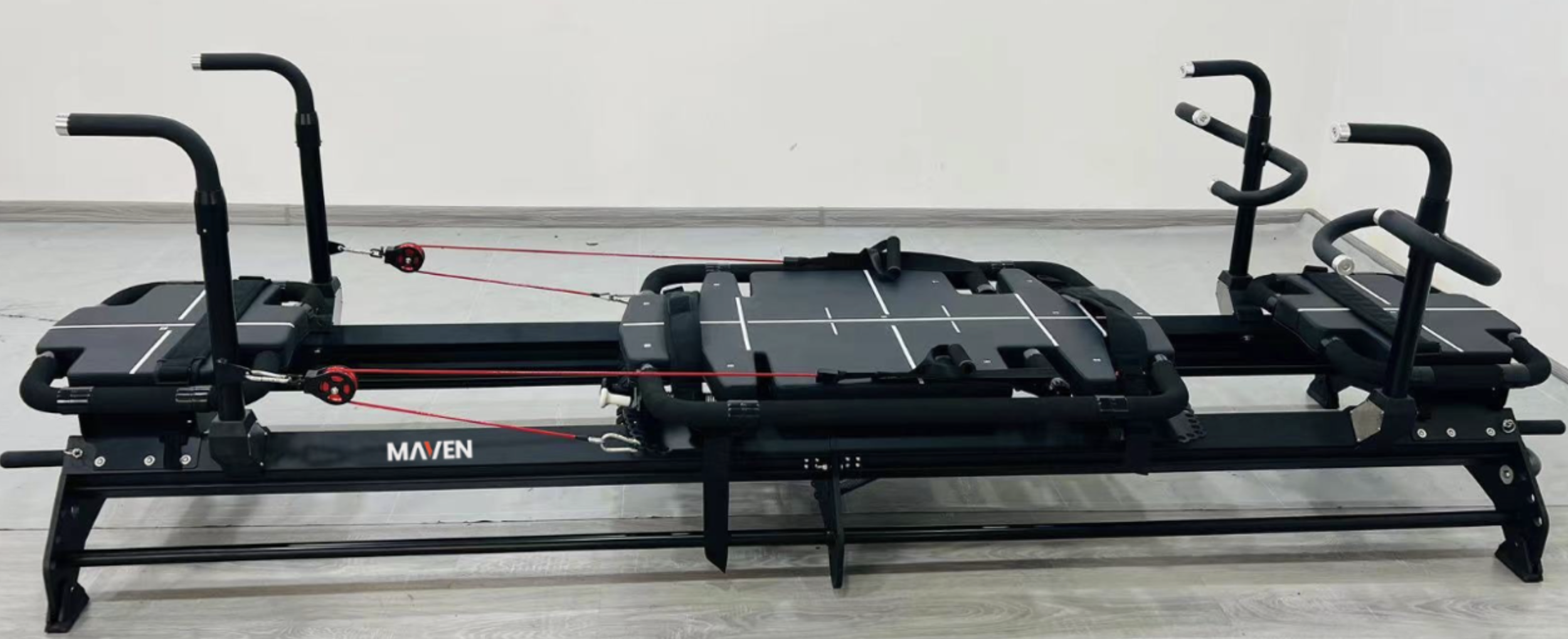
STABLE & UNSTABLE PARTS OF THE BODY
-
Instability: Upper body is mobile → core must stabilize the torso and spine
Direction of resistance: Carriage moves under the shoulders or torsoEffect on Contraction:
Greater upper core (rectus abdominis, obliques) recruitment — since your rib cage is what’s moving toward the pelvis.
More anti-extension demand — you’re resisting the carriage pulling you into spinal extension.
Deep core (transverse abdominis) works isometrically to prevent the spine from arching.
Shoulders, serratus, and lats fire to stabilize the scapulae.
Cue Focus:
“Draw ribs to hips,” “zip the front body,” “press the carriage away without collapsing the core.” -
Instability: Lower body is mobile → core must stabilize the pelvis and legs
Direction of resistance: Carriage moves under the hips or legs
Effect on Contraction:
More lower core and hip flexor recruitment — since the pelvis is the moving end.
Requires more anti-anterior-tilt control — abs fire to keep the pelvis neutral as the carriage moves.
Glutes and hamstrings assist to control leg extension and pelvic stability.
The contraction tends to feel deeper and lower (think lower abs engagement).
Cue Focus:
“Pull the carriage from your lower abs,” “keep your ribs heavy,” “draw hip points toward ribs.” -
Instability: Carriage moves under the lower body
Resistance direction: Springs pull from below/behind
Effect on Contraction:
Core → Anti-extension + dynamic stabilization. The abdominals resist the lumbar spine from arching as legs move.
Transverse abdominis and obliques work hard to stabilize and prevent rotation or sagging.
Shoulders and lats are strong stabilizers since arms are anchored to a stable surface.
Lower abs often feel the burn more, since legs are the moving end.
Cue Focus:
“Pull from your lower abs.”
“Keep ribs and hips connected.”
“Resist the carriage returning.”
Overall feel: Deep core stability with a lower-ab and shoulder stabilization.
-
Instability: Carriage moves under the upper body
Resistance direction: Springs pull toward the platform
Effect on Contraction:
Core → Anti-extension + spinal flexion. You’re bringing ribs toward hips against spring tension.
Rectus abdominis is the main mover; upper abs feel more active.
Hip flexors and quads anchor the lower body, keeping pelvis stable.
Upper body and shoulders work to control the carriage — high demand on serratus, pecs, and lats.
Cue Focus:
“Draw ribs to hips.”
“Pull the carriage in from your core, not your arms.”
“Keep your hips heavy.”
Overall feel:
More upper-abdomen, chest, and arm integration.
When you flip the body position (lower body on the carriage vs. upper body on the carriage), you’re essentially changing where the instability and resistance come from, which shifts muscle activation, intensity, and contraction type in the core and surrounding stabilizers.
OTHER CONSIDERATIONS
Tempo:
We move to a slow four count (1, 2, 3, 4)
Push the carriage out to a slow four and then back in
Transitions:
We smoothly transition you between moveS to optimize your workout
We do not call out breaks, but if you need one please take it!
Your safety is our top priority
Pelvic Tilt: Brace your core like your are anticipating a punch to the gut/being tickled
Flick the Tailbone: Extend the spine