
What Happens When You Add Pilates-Inspired Strength to Your Lifting Routine
At some point, most lifters hit the same wall.
Your lifts aren’t necessarily getting worse, but they’re not really getting better either. Your hips feel tight. Your low back always feels “on.” Your shoulders fight you overhead. Recovery takes longer than it used to. And eventually, your body starts forcing you to work around things instead of through them. The burnout is real.
Most people assume they just need to push harder to get past their plateau. But a lot of the time, the thing limiting your lifting isn’t effort.
It’s an approach to movement that makes building muscle significantly better.
That’s where Pilates-inspired strength training changes things.
YOUR CORE GETS STRONG ENOUGH TO SUPPORT THE WEIGHT YOU WANT TO LIFT
You might have visual abs, you might not. But how often are you using your core to push your heavy lifts?
How often do you brace under load, stabilize your spine, control rotation, and transfer force more efficiently through your body? You’ll know if you aren’t because you’ll quickly feel it in your low back, hips, and shoulders.
That’s why so many lifters keep trying to level up their weight while their body is quietly compensating underneath it leading to plateau, or worse injury.
At Core (LP), we slow things down enough to expose where that strength is missing. The slower tempo and constant tension force your stabilizers and deep core muscles to do their job properly instead of letting bigger muscle groups take over and overcompensate for the muscles not being appropriately recruited.
Stronger core = stronger lifts
MOBILITY STOPS BEING THE THING YOU BLAME EVERYTHING ON
“Tight hips.”
“Bad ankle mobility.”
“My low back is always stiff.”
Most of the time those things are real. But they’re also usually tied to mobility.
Pilates-inspired strength training builds mobility through controlled resistance and full range of motion. We love stretching, but there isn’t enough load to build the foundational strength to support the type of weight you’re probably using in the gym.
Without flexibility, you significantly decrease how productive your lifts are and how your joints support it.
Flexibility is what improves squat depth, overhead positioning, hinging mechanics, rotation, and overall movement quality. Instead of constantly working around restrictions, your body starts moving through them with more support.
So yeah, mobility matters. A lot.
Especially if you want to keep lifting long-term.
YOU BUILD STRENGTH IN THE POSITIONS YOU USUALLY RUSH THROUGH
Typically lifting programs focus on producing force.
Pilates-inspired strength training focuses on controlling it.
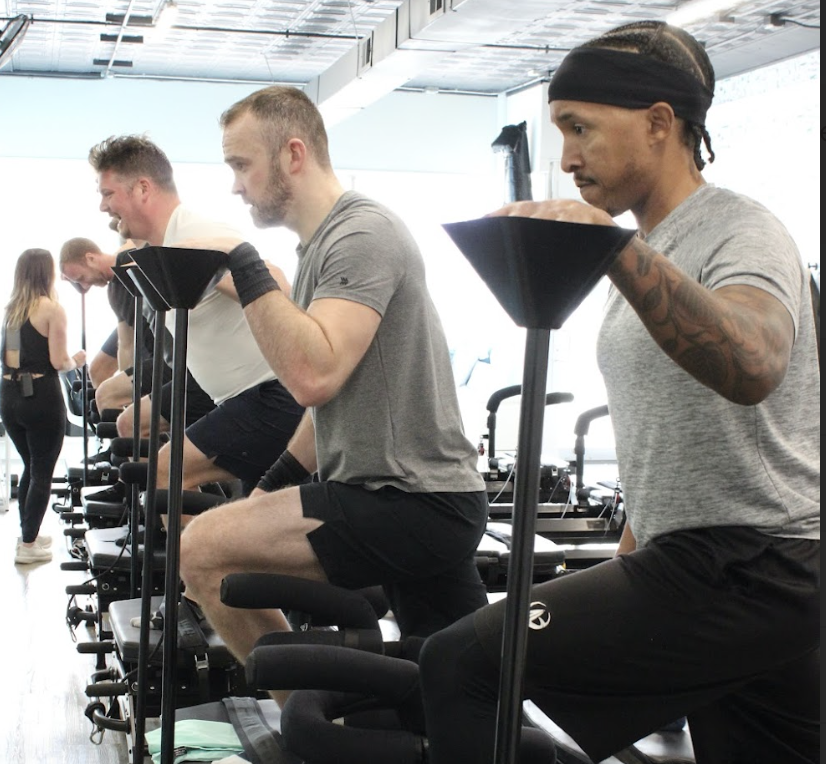
The slower tempo and time-under-tension format force you to stay in the parts of movements most people rush through:
the bottom of a squat
the shake in a lunge
planks
shoulder and upper back stabilization
And because you can’t use momentum to bail yourself out, your stabilizers are forced to do the work (and yes get stronger).
You’ll start to notice that one side is compensating more than the other, or your core checks out the second fatigue hits. And no you aren’t weak. Pilates-inspired strength training just clocks those tiny imbalances that traditional lifting can hide for a long time despite how your body looks or the number you clock in your bench press at.
THIS IS WHY MANY LIFTERS USE IT AS A FULL BODY DAY
Pilates-inspired strength training creates a strong muscular stimulus without the same level of joint impact and heavy spinal loading that comes from constantly training at high force output. For a lot of lifters, it helps reduce stiffness, improve mobility between lifting days, improve circulation, and keep the body moving without feeling completely destroyed afterward. That said, you are still breaking your muscle fibers down during sessions which requires appropriate recovery on its own.
Some lifters use Pilates-inspired strength training as a full body training day. Others pair it into their split alongside upper or lower body lifting days.
At Core (LP), some clients use our Treble classes alongside upper body focused training, Bassline classes alongside lower body splits, or use full body sessions to support performance, mobility, and endurance all at once.
It doesn’t have to replace your lifting if that’s what you enjoy (it can if you don’t), but it supports the part of training heavy lifting alone doesn’t always build well.
THE DEBATE ISN’T PILATES VS STRENGTH TRAINING
By simply adding in Pilates-Inspired Strength Training to your lifting routine 1-2 times per week, you can drastically improve support the force needed to power up heavy lifts as well as increase:
mobility
control
stability
endurance
recovery
and core strength (by like a lot)
And honestly? That’s usually the stuff lifters ignore until their body forces them to pay attention to it.
At Core (LP) in Berkley and Rochester Hills, Pilates-inspired strength training is designed to help you move better, recover better, and keep progressing long after brute force stops being effective.
👉 Book a consult and we’ll help you figure out how to integrate Pilates-inspired strength training into your current lifting routine.
