
Why Lifters Plateau Without Mobility Training
You’ve been lifting for years. You’re consistent and you know how to push yourself. But at some point, things stop moving the way they used to. Your mobility feels tighter. Recovery drags. Your lifts aren’t necessarily getting worse, but they’re not getting better either. You notice your body just can’t push past a certain point, or worse you just stop doing that exercise all together. That’s why the best athletes and lifters are moving towards adding mobility training.
IF YOUR LIFTS HAVE STALLED, IT’S PROBABLY NOT A STRENGTH PROBLEM
If your hips, shoulders, back, or ankles are constantly tight, you physically can’t get into better positions. That means your squat, press, or hinge stops improving. You can only produce force in positions you can control. And most lifters, even experienced ones, are operating inside a limited range without realizing it. You hit depth… but not really. You lock out… but with compensation. Over time, your body gets very good at working around restrictions instead of correcting them. We know ignoring “the thing” never means it goes away. That becomes your ceiling.
THE REFORMER IS THE THING YOUR DUMBBELLS CAN’T REACH
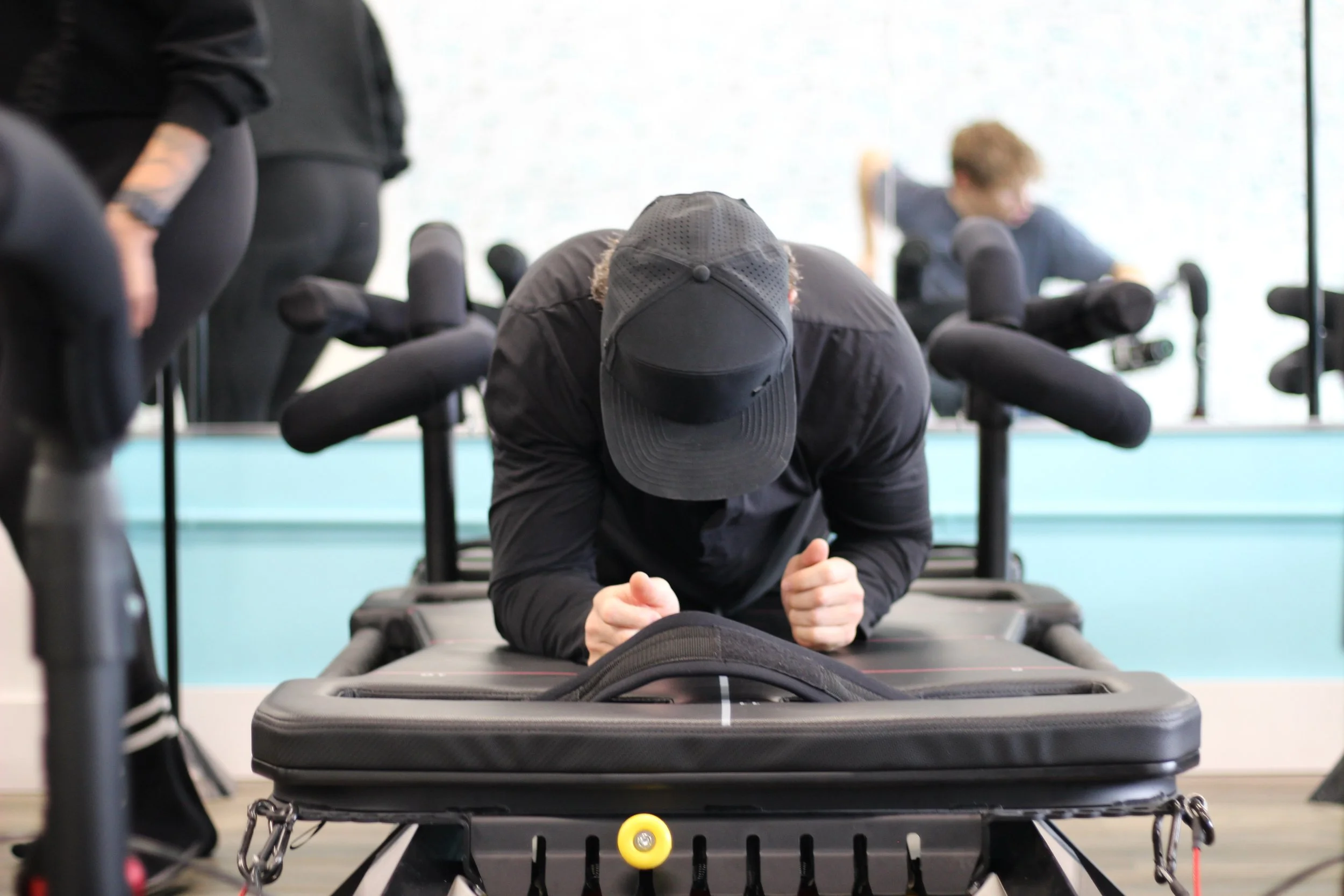
Pilates-inspired strength training forces you into the ranges you’ve been avoiding. By keeping under constant tension, and controlled movements, you can’t use momentum to bail you out. Think about the bottom of your squat, the core control in your overhead press, and the hinge in your deadlifts, these are the places your lifts usually break down. Not because you’re weak, but because you’ve never had to stay there long enough to build strength there, limiting how much more your can support building weight later.
The time-under-tension format at Core (LP) Berkley & Rochester Hills we pair deep core workout routines with full body movements without the same level of fatigue and soreness that often comes with heavy barbell lifting. You’re still working at a high intensity, but the output is controlled in a way that doesn’t interfere with the rest of your training week. For many lifters, it functions as active recovery or a full body day that still contributes to strength.
HOW CONTROL AND STABILITY IMPROVE PERFORMANCE
When training shifts away from force only, and starts using controlled movements, you progress faster and can lift form a place of support leading to less injury and joint issues. By focusing on balance, mobility, better range of motion, deep core strength, as well as pushing & pulling tension, we hit the areas that don’t typically get trained during traditional lifting.
WHY COMPENSATION LEADS TO INJURY AND PLATEAUS
Your body is smart. If one joint won’t move, another one will pick up the slack. Both sides look fine under a barbell, but when the base of support changes or tempo slows down, differences become obvious. One side takes over. The core stops stabilizing evenly. Movement shifts to compensation instead of control. And that’s how you end up overusing your lower back in deadlifts or your traps in pressing. You’re still lifting, but not efficiently.
Core (LP) exposes those differences quickly because there is no momentum to rely on and no way to “rush” through weak positions. The slower tempo also changes how eccentric loading is handled. Every rep requires control while lengthening and while returning to start.
Think of it this way, your hamstrings stretch, your shoulders have to stabilize over head, and your knees have to control force in deep ranges. These are the top injuries that sideline lifters and athletes from lifting. Training that repeatedly loads those positions under control and balanced core strength helps build tolerance and stability where it tends to be missing.
WHEN FORM ISSUES ARE ACTUALLY MOBILITY ISSUES
Everyone says “fix your form,” but form is often a mobility issue in disguise. You can’t clean up your squat depth if your ankles and hips won’t allow it. For lifters dealing with tightness, recurring irritation, or reduced range of motion over time, this type of training supports the ability to keep training consistently. It doesn’t have to replace lifting but it can drastically improve how the body handles it by addressing the positions and control that heavy lifting alone doesn’t always reinforce.
THE BEST WEIGHTLIFTING EXERCISES FOR ABS
More and more athletes and lifters are adding Pilates-inspired strength training into their routines, because it fills the gaps their primary training leaves behind. When your range of motion and core strength improves, your control improves. When your control improves, your lifts follow.
If you’re putting in the work but not seeing it carry over the way it should, it might not be a strength problem. It’s probably a control problem. And that’s exactly what we train at Core (LP) Berkley & Rochester Hills.
RESOURCES:
